
Controlled Atmosphere Stunning (CAS) dominates modern broiler processing because it avoids live shackling, improves line flow, and can deliver consistent insensibility at scale. But conventional, carbon-dioxide–based CAS has well-documented welfare drawbacks (notably aversion and respiratory distress during induction).
Over the past decade, Low Atmospheric Pressure Stunning (LAPS)—a computer-controlled, slow decompression that induces progressive hypoxia—has matured from trials to regulatory acceptance for broilers up to 4 kg in the EU. A growing body of research and official opinions indicates LAPS can achieve welfare at least equivalent to permitted methods, with unique practical benefits that make it a genuine alternative where plant design and product mix align.
Where CAS stands today and what it means in practice
CAS is a family of gas-based systems that render birds insensible in sealed tunnels or chambers before shackling/bleeding. Commercial variants include:
CO₂ in two or multi-stages (hypercapnic hypoxia). Birds encounter sub-lethal CO₂ first, then higher concentrations to ensure death or a non-recoverable stun prior to bleed.
Inert-gas systems (nitrogen and/or argon) that displace oxygen to cause anoxia, sometimes combined with reduced CO₂ to temper aversion.
These systems are valued for eliminating live shackling, smoothing logistics from lairage to evisceration, and often improving product yields versus water-bath stunning. However, welfare concerns persist—especially with CO₂ alone—including head shaking, gasping, and other aversion indicators during induction. Research exploring mixed-gas profiles (e.g., CO₂ + N₂) aims to reduce those responses while maintaining efficiency.
Welfare: progress, with caveats
Reviews of CAS note the significant upside—no pre-stun shackling—alongside the downside that CO₂ levels above ~30% trigger intrapulmonary chemoreceptors linked to discomfort.
Inerts or CO₂-inert blends can mitigate this, and recent work suggests CO₂ + N₂ mixtures speed loss of consciousness and reduce aversion compared with classic two-phase CO₂.
Nonetheless, plant-level performance depends on gas recipes, dwell times, bird condition, stocking density, and control of leaks and flows.
LAPS in a nutshell – Mechanism and control philosophy
Low Atmospheric Pressure Stunning (LAPS) renders birds unconscious by gradually lowering air pressure in a closed chamber under computer control. The controlled decompression reduces oxygen tension steadily, producing progressive hypoxia until birds pass into insensibility and a non-recovery state before bleeding.
Unlike gas dosing, the “stunning agent” is simply the absence of oxygen achieved via pressure control, with chamber rate-of-change, hold time, and cycle profile validated for bird size and condition.
What the science says
Multiple assessments—including EFSA’s 2017 scientific opinion specific to broilers—conclude that LAPS can provide a level of animal welfare not lower than at least one currently allowed method, when used under the specified technical conditions (broilers <4 kg, defined pressure profile, etc.).
Independent reviews comparing CO₂-based CAS, nitrogen anoxia, and LAPS indicate that nitrogen and LAPS are both welfare refinements relative to CO₂-only regimes because they avoid CO₂’s chemoreceptor-mediated aversion.
Behavioural studies in broilers during LAPS (e.g., loss-of-posture timings and absence of vigorous escape behaviours) support that interpretation, though—as with any method—parameters must be tightly controlled to avoid suboptimal transitions.
Regulatory status
Following EFSA’s favourable opinions, the EU amended Regulation (EC) No 1099/2009 via Commission Implementing Regulation (EU) 2018/723, adding LAPS for broilers below 4 kg subject to technical specifications. Individual national approvals and enforcement follow the EU framework. Outside the EU, authorisation depends on national competent authorities; adoption patterns vary by market and supply-chain requirements.
How LAPS compares with mainstream CAS on the plant floor – Welfare risks & hazard profiles
EFSA’s hazard mapping of stunning methods highlights different clusters of welfare risks. CAS with CO₂ carries aversion-related risks during early exposure; nitrogen/inert approaches lower those specific risks but raise others tied to control of O₂ displacement and chamber management.
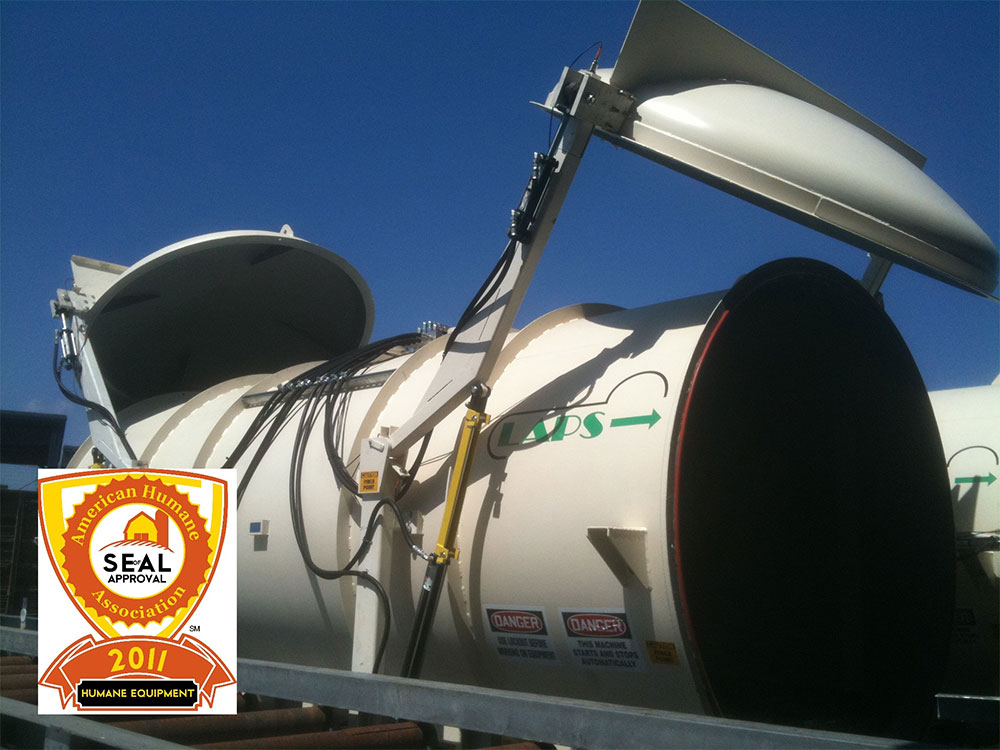
LAPS removes gas aversion from the equation and shifts the critical control points to pressure-profile accuracy, cycle validation, and bird loading density. Manufacturers and independent collations of EFSA’s hazard rankings reflect this trade-off landscape.
Product quality, yields, and downgrades
Published comparisons of meat quality across ES (electrical stunning), CO₂-CAS, and alternative modalities show plant-to-plant variability. Some reports note less CO₂-associated haemorrhage and more uniform bleed-out when moving away from water-bath stunning.
In contrast, others show mixed effects on breast myopathies and redness depending on exact parameters. Reviews suggest nitrogen and LAPS avoid hypercapnia-linked physiological stressors that can influence haemorrhages and pH dynamics, but—as with CAS generally—outcomes hinge on line settings and post-stun handling.
Throughput & integration
Both CAS and LAPS are modular, batch/tunnel systems designed to interface with containerised live receiving. CAS typically uses multi-stage gas tunnels; LAPS uses pressure-rated chambers. Either can be engineered to match high line speeds; practical capacity depends on chamber volume, cycle time, crate/line logistics, and redundancy (e.g., twin-chamber layouts).
Plants contemplating a switch often treat LAPS as a like-for-like module in the live-hang area with different utilities (vacuum pumps vs bulk CO₂/N₂ storage), different maintenance skill sets, and a distinct set of critical control points. (Engineering specifics are proprietary by vendor; due diligence pilots are recommended.)
Occupational safety & utilities
CAS requires gas storage and distribution (CO₂ and/or N₂/Ar), gas detection, and ventilation safeguards. LAPS shifts risk management to vacuum and structural integrity (chambers, seals, interlocks) and electrical/controls reliability. Either way, robust maintenance, calibration, and alarms are non-negotiable.
Why LAPS can be a genuine alternative
- Welfare parity (or better vs CO₂-CAS on induction experience): EFSA’s 2017 opinion concluded LAPS achieves welfare not lower than at least one authorised method for broilers <4 kg, and independent reviews indicate LAPS and nitrogen approaches avoid CO₂ aversion, a persistent criticism of classic CO₂ CAS.
- Regulatory clarity in the EU: The method is explicitly listed under EU law for broilers <4 kg via 2018/723, providing a harmonised compliance pathway across Member States (subject to national implementation).
- Process simplicity (no bulk CO₂ handling): By using pressure change rather than supplied gases, LAPS removes one significant operational dependency and some safety systems tied to gas logistics—trading them for vacuum/chamber controls and maintenance.
- Consistent, programmable profiles: LAPS’ computer-controlled decompression curve is intrinsically repeatable; once validated for bird mass and crate density, it can be locked down with monitoring and alarms, similar to validated CAS recipes but without gas concentration drift issues.
- Alignment with evolving welfare expectations: As research continues to question CO₂ aversion and prioritise calmer inductions, solutions that avoid hypercapnia (nitrogen CAS or LAPS) are gaining traction in audits and brand standards. Recent studies showing improved welfare with CO₂ + N₂ in CAS reinforce the broader trend away from CO₂-only. LAPS sits squarely within that trajectory.
CAS remains an effective, widely adopted way to avoid the handling and shackling stress of traditional water-bath stunning—but the CO₂ aversion problem is hard to ignore. LAPS offers a compelling alternative pathway to the same operational benefits, with a distinct welfare profile built on progressive hypoxia without CO₂.
With EU-level recognition for broilers under 4 kg and a research base that continues to fill out performance, many plants will find LAPS belongs on the shortlist whenever they’re refurbishing live-receive or aiming to upgrade welfare outcomes without sacrificing throughput.
To find out more about LAPS, please call us on +44 (0)1379 872800.